Relativism and the Foundations of Liberalism by Graham Long
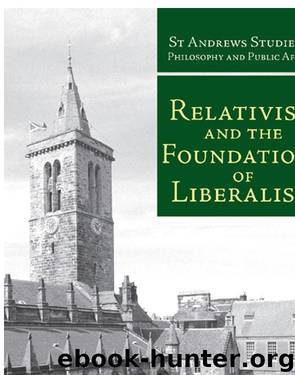
Author:Graham Long
Language: eng
Format: epub
Tags: Relativism, Liberalism, Democracy, liberal, politics, political, philosophy, morals, moral, morality, ethics, universal, universalist, Harman, Nagel, Habermas, Rawls, Barry, thought, justification, Coherance Relativism
ISBN: 9781845402693
Publisher: Andrews UK Limited 2011
Published: 2011-09-30T00:00:00+00:00
Diversity has certainly been the impetus moving many to relativism. It might, by means of an argument showing that relativism c an account f or widespread diversity b etter t han universalism, constitute evidence for relativism. However, without a justificatory strategy explaining how moral justification allows for there to be more than a single true morality, it does not constitute any non-vacuous form of relativism itself.
A priori coherence relativism raises a number of issues straightaway. Some of these can be put in terms of the problems for relativism that I outlined in chapter two, and I will address these questions in the remainder of this chapter and in chapter five. I want to begin by answering a criticism that might be thought to immediately refute an understanding of reflective equilibrium as a relativist account of justification. This is the claim, made by Kai Nielsen, that reflective equilibrium yields universal and objective principles. Looking at his conception of reflective equilibrium will demonstrate some of the features of reflective equilibrium that lend themselves to a relativist interpretation. I then move on to examine the claim of objectivity present in Nielsen’s interpretation. If many coherent equilibria will emerge, how can anyone claim that his or her equilibrium is objectively correct? The question of objectivity has dogged relativism throughout its history, and I believe coherence relativism can make a worthwhile response. In doing so, I will also answer the charge that relativism renders morality arbitrary. As indicated in chapter two, whilst I will not discuss my relativism in terms of truth I must at least provide an account of the objectivity that can be claimed for it. Section five then addresses the problem of theory choice indeterminacy, a problem for relativism that was also raised in chapter two. Drawing on my discussion of considered moral judgements earlier in this chapter, I present a resolution to the question of how to decide between competing moral frameworks. My answers to these questions will lay the groundwork for a full discussion of the remaining elements of our moral experience which emerged from the work of chapter three. The discussion of these - moral disagreement, moral horror and moral criticism - follow in chapter five.
Are Relativism and Reflective Equilibrium Really Compatible?
I have suggested that one reasonable and consistent interpretation of reflective equilibrium is relativist - i.e. it specifies standards of justification that can be met by multiple moralities. Kai Nielsen, in his article ‘Relativism and Wide Reflective Equilibrium’ (1993) challenges such a position head on, arguing that Wide Reflective Equilibrium carries no relativist implications. Obviously, if Nielsen is right, and my position is included in those described by Nielsen as relativist, then I am wrong. However, I do not believe that Nielsen’s argument renders my position incoherent or even implausible. Here I will indicate why I believe this to be the case, by setting out Nielsen’s argument and then my criticisms of it.
Nielsen distinguishes between the two forms of relativism that I set out in chapter two: ethical (normative) and metaethical.
Download
This site does not store any files on its server. We only index and link to content provided by other sites. Please contact the content providers to delete copyright contents if any and email us, we'll remove relevant links or contents immediately.
| Anthropology | Archaeology |
| Philosophy | Politics & Government |
| Social Sciences | Sociology |
| Women's Studies |
The remains of the day by Kazuo Ishiguro(9082)
Tools of Titans by Timothy Ferriss(8490)
Giovanni's Room by James Baldwin(7432)
The Black Swan by Nassim Nicholas Taleb(7194)
Inner Engineering: A Yogi's Guide to Joy by Sadhguru(6835)
The Way of Zen by Alan W. Watts(6670)
The Power of Now: A Guide to Spiritual Enlightenment by Eckhart Tolle(5854)
Asking the Right Questions: A Guide to Critical Thinking by M. Neil Browne & Stuart M. Keeley(5831)
The Six Wives Of Henry VIII (WOMEN IN HISTORY) by Fraser Antonia(5557)
Astrophysics for People in a Hurry by Neil DeGrasse Tyson(5224)
Housekeeping by Marilynne Robinson(4503)
Double Down (Diary of a Wimpy Kid Book 11) by Jeff Kinney(4332)
12 Rules for Life by Jordan B. Peterson(4331)
Ikigai by Héctor García & Francesc Miralles(4310)
The Ethical Slut by Janet W. Hardy(4307)
Skin in the Game by Nassim Nicholas Taleb(4306)
The Art of Happiness by The Dalai Lama(4167)
Skin in the Game: Hidden Asymmetries in Daily Life by Nassim Nicholas Taleb(4050)
Walking by Henry David Thoreau(3998)
